

Thursday, September 6, 2018
“The Wizard of Oz”: We're not in Kansas anymore.

With all of the issues that happened before The Wizard of Oz began filming, MGM was probably hoping for a smooth production. With both the original wicked witch and director replaced before principal photography began, Louis B. Mayer was hopeful that the worst was over. That would not prove to be the case. A series of catastrophic events would befall the production.

The first casualty of the production was Buddy Ebsen. MGM’s famed makeup and design team was trying to ensure that Oz popped on screen. The silver paint they were using for the Tin Man caused a severe reaction in Buddy Ebsen. Ebsen collapsed on the set and was rushed to the hospital, where he lay in a coma for several days. According to legend he awoke to see Louis B. Mayer, nervously fidgeting in the hospital room. Mayer then broke the news that he was replaced by Jack Haley. Haley, meanwhile, had not been told what happened to Ebsen and assumed that Buddy had been fired. It is probably unlikely that Mayer had the time to sit at Ebsen’s bedside to break the news to him personally. However, it is definitely believable that MGM didn’t tell Jack Haley about the health problems the Tin Man makeup caused. They needed him to suit up and shut up.

The production hadn’t gotten too far behind, but Mervyn LeRoy took advantage of the minor delay to replace director Richard Thorpe with George Cukor. Cukor made huge changes to the film. Originally, Judy Garland was outfitted in a blonde wig and babydoll dress. Cukor wanted her to play Dorothy more naturally, so the wig was removed and the familiar blue gingham dress used. In order to save money, Jack Haley only re-recorded a few of Ebsen’s singing lines. Therefore Ebsen’s singing performance remained in the final film.

Cukor’s time on the set would be short. MGM saw the production as troubled and had only hired him to get things back on track. Victor Fleming would arrive in November of 1938 to handle the bulk of the directing duties. Fleming would suffer through the six month slog of filming the technicolor scenes before being pulled off to finish Gone With the Wind. The technicolor scenes were a nightmare for cast and crew. The lighting required for each scene made the sound stages extremely hot and the makeup and heavy costumes unbearable. Margaret Hamilton was the second casualty of the shoot, suffering third degree burns during the scene in which she vanishes in Munchkinland. The injury caused her to refuse doing more special effects scenes. It was a good decision- the stand-in hired to replace her was injured as well.

King Vidor was brought in to finally wrap things up on this very expensive project. Production finally ended in June 1939, just weeks before the planned release. Despite the delays and issues, the picture still came in close to its budget. Now it would be up to the audiences. Would this Wizard bring in as many customers as Snow White?

Wednesday, September 5, 2018
“The Wizard of Oz”: People Come and Go So Quickly Here!
While The Wizard of Oz script was still being worked out, MGM set about casting the film. Casting the film turned out to be no easier than finalizing the script. Originally Shirley Temple was considered for the iconic role of Dorothy. She was the biggest young star at the time, but was signed to Twentieth Century Fox. MGM reportedly started negotiating to borrow Miss Temple from Fox, but once it was decided to produce The Wizard of Oz as a full fledged musical, she was not seen as being suitable for the role.

Shirley Temple, Judy Garland, Mickey Rooney and Louis B. Mayer
The MGM Casting directors soon turned their attention to Deanna Durbin, who was also under contract to another studio. As the script and songs began to finalize, however, her singing voice was not seen as being suitable for the role.

Of course, MGM contract player Judy Garland would eventually take the iconic role of Dorothy, which turned her into a superstar.

The next major roles to get cast were the Scarecrow and Tin Man. Buddy Ebsen was cast as the Scarecrow and Ray Bolger as the Tin Man. Bolger, however, had always wanted to play the scarecrow. MGM decided to grant his request and swapped their parts. Bert Lahr was the last of Dorothy’s friends to get cast in the film.

Buddy Ebsen, Ray Bolger, Judy Garland and Bert Lahr
The biggest challenge, however, was casting the dwarves who would portray the Munchkins. MGM needed hundreds of them to completely fill out Munchkinland. MGM was unable to finish the casting before production began, so the Munchkinland sequence was one of the last scenes filmed. MGM looked far and wide for little people who could sing, dance and act and flew them all out to Hollywood. The film would be a defining moment for the dwarves cast in it; most of them had never met another little person before. While their behavior on set was legendarily exaggerated, they were quite a raucous bunch.

For the actual Wizard of Oz, MGM looked outside its lot at first, wooing W.C. Fields for the role. As negotiations with Fields dragged on, the studio chose an MGM contract player- Frank Morgan to portray the Wizard. A similar issue came up with casting the wicked witch. MGM reached outside its fabled contract roster to hire Gale Sondergaard to portray the witch. Ms. Sondergaard was excited to play the role at first, mainly because the intent was to make the witch more glamorous, like in Snow White and the Seven Dwarfs.
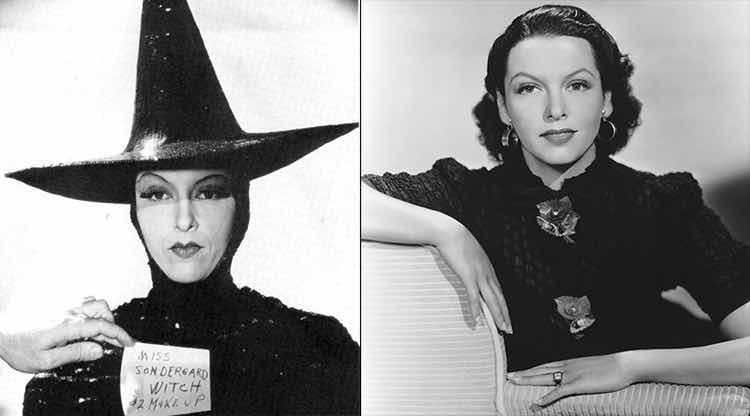
Gale Sondergaard
However, the character soon morphed into a more traditional, haggish witch. Gale was not interested in portraying such a character and bailed out just days before the shooting was supposed to begin. MGM turned to Margaret Hamilton, another MGM contract player to take the role.

Margaret Hamilton
Production on the film would begin in mid-October of 1938, with the film’s release planned for August of 1939. That the project ran into so many problems- with both script and casting- and still made it to production is a testament to MGM’s movie making machine. The film would need even more help as filming began.
Tuesday, September 4, 2018
“The Wizard of Oz”: Follow the Yellow Brick Road

Once The Wizard of Oz was greenlit, the massive MGM production machine went into action. The script hadn’t been completed yet, but producer Mervyn LeRoy knew that Munchkinland, the Yellow Brick Road and The Emerald City would be major set pieces. MGM’s famed set crew was authorized to begin building the sets while the script was being worked on.

The first draft was soundly rejected. It ignored the fantasy aspect of the film and made Dorothy’s three friends regular guys whose defining traits were more realistic. In the first draft, the first friend she came across wasn’t a scarecrow come to life; it was an extremely stupid man who could only find work trying to scare crows in a field. The tin man would have been a heartless criminal who had been sentenced to live in a tin suit. The idea of Oz being a more grounded, realistic world had been previously explored in the 1925 version produced by Samuel Goldwyn. Louis B. Mayer wanted a more fanciful version, capable of competing with Walt Disney’s animated films. This idea was scrapped, though the ‘it was all a Dream’ aspect of the final film was inspired by this draft.

While set preparation and casting was going full speed ahead, script development was lagging behind. The final shooting script was completed on October 8, 1938, officially credited to Noel Langley, Florence Ryerson and Edgar Allan Woolf. The full list of script contributors, however, included over ten people. Among the others who contributed to the script were Hollywood legends Victor Fleming, Herman J. Mankiewicz, King Vidor, Bert Lahr and Jack Haley.

Amazingly, filming would begin just five days after the script was finalized. Could a huge production made from a frankenscript that had barely been finished five days before production began finish in time and turn out to be any good? Maybe not at lesser studios, but this was MGM. Even more amazingly, script problems would be the least of Louis B. Mayer’s worries. Things wouldn’t get easier for this trouble-plagued production.
Monday, September 3, 2018
“The Wizard of Oz”: The Machine Behind The Curtain
Making a motion picture has always been a massive undertaking. In order to introduce some sanity to the process, MGM had turned the art of show into a business. Its legendary motion picture machine could produce films more efficiently, more quickly and more successfully than any other studio. While it couldn’t completely eliminate the problems that could crop up on a motion picture, it could minimize their effects. One such film that might have collapsed under a less regimented production process was 1939’s The Wizard of Oz.

The success of Walt Disney’s Snow White and the Seven Dwarfs swept through Hollywood like an earthquake. Here was a musical feature, produced by an independent studio, that had shot to the top of the box office. The film sparked the infamous “box office poison” letter which called out Hollywood Stars for their excesses. If a cartoon princess could capture the hearts of the world, who needed Mae West or Clark Gable? The most notable studio chief who took offense at this turn of events was Louis B. Mayer. A musical such as Snow White and the Seven Dwarfs, had it not been animated, was MGM’s domain. Mayer pledged to beat back this interloper by producing a family musical picture that would rival Snow White and the Seven Dwarfs. He just needed the right material.

He thought he might have found it in L. Frank Baum’s Oz books. Samuel Goldwyn, whose Goldwyn Pictures had been absorbed into MGM, had purchased the Oz rights in the 1920’s and produced a 1925 silent picture based on the books. Mayer’s interest was further piqued when he discovered that Walt Disney was interested in the property as well. Walt Disney Productions in 1938 was no match for MGM. Louis B. Mayer acquired the rights and fast tracked a grand musical in the MGM tradition, based on L. Frank Baum’s Oz books.

The Wizard of Oz would have the full resources of MGM behind it. How else could a gigantic project such as this one which had no script at that time get produced quickly enough to be released the following year? The production would soon run into several catastrophic roadblocks that might have sunk films that were produced by lesser studios. The Wizard of Oz, however, was being produced by the all powerful MGM. Louis B. Mayer was the one man in Hollywood who was just as powerful (if not more so) than the Wizard of Oz. If anyone could get this complicated picture made, it would be him.
Sunday, September 2, 2018

Saturday, September 1, 2018

Subscribe to:
Posts (Atom)